Foundation maps
Short recorded courses on the Galaxy Maps platform, free to any young person, at school or at home. Every map ends in something the learner makes.
- Who
- All Cook Islands mapu
- Pace
- Self-paced
- Size
- 8 maps, 2–4 hours each
- Cost
- None

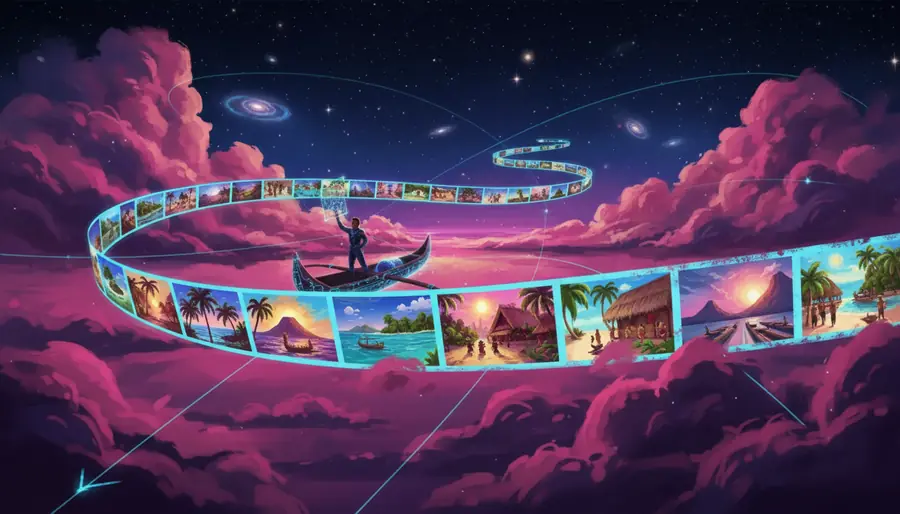
Every star is a mission. Every line is a route a learner can take.
Free digital technology learning for every young person in the Cook Islands — on your own island, on your own device, at your own pace.
Short digital technology courses, open to any young Cook Islander at no cost. Each one runs two to four hours and ends in something you have made — not a quiz. They are in production now.
The programme has three stages. The first is open to every young Cook Islander on every island. Each stage after that is an invitation, earned by what you have already done. The group gets smaller and the mentoring gets closer at each step.
Short recorded courses on the Galaxy Maps platform, free to any young person, at school or at home. Every map ends in something the learner makes.
A cohort of apprentices who have finished five foundation maps and made something of their own. One year, four terms of mentor-monitored maps, with a laptop on loan.
Graduates who finish the Academy and ship a working project are paired with a mentor inside Tai Collective and work on live projects for island organisations.
A household on Mitiaro can now buy much the same connection as a household in Auckland. What it cannot buy is anyone to teach its fifteen-year-old what to do with it.
There is no digital technologies learning area in the national curriculum, and no computing qualification taught on any island. The existing route for a young person who wants a technical career is to leave home at fifteen and board somewhere else.
We are building a route that does not require them to leave.
Built for a shared laptop and a slow connection, and for short sittings. Every example uses Cook Islands material — real power bills, real reef data, real photographs.

You makeA tidy file system and a first terminal session

You makeA map of how the internet reaches your island

You makeA published web page about your island

You makeA script that automates a real chore

You makeA measured solar phone charger

You makeA chart from real local data, with a claim it supports

You makeA verified answer, and a documented case where the AI was wrong

You makeA two-minute video, shot and edited on a phone
Remote mentoring rests on relationships built face to face. The captain visits the islands in person — meeting principals, teachers, families and the island government, installing and testing equipment, and setting up the routine each island will run: where learners work, when devices charge, how they connect, and who to call when something breaks.
Return visits keep those relationships alive, film local material for the maps, and hand day-to-day support to local learning champions. The visits are also where apprentices meet their captain in person.
Any island that cannot be reached in a given year is set up remotely and visited the next.
The platform logs when an apprentice starts and completes each mission. The captain sees the whole cohort on one screen: who is moving and who has stalled.
Apprentices submit what they made. The captain reviews it and sends it back with comments when it needs another pass.
A help request goes straight to the captain, who replies within two working days. Asking a good question is taught, and it counts.
Anyone stalled for ten days gets a personal check-in. There is a weekly online session for the whole cohort, plus a logbook reviewed each term.
A parent or guardian consents before anyone under 18 enrols, and signs the laptop loan agreement.
Sessions are group sessions by default. One-to-one sessions with under-18s are scheduled, logged and open to a parent to join. Everyone mentoring holds a current police check.
Progress data is used for mentoring and reporting, never sold, and never used for advertising. Reporting is in totals, not names.
Sessions are not recorded by default. Families can see what is held about their child and ask for it to be deleted.
Avaiki Tech Academy is built and delivered by Tai Collective, which has run youth technology programmes for six years and is now based on Mauke. It runs on Galaxy Maps, a learning platform in development since 2021, which records every learner's progress so a mentor can follow it from another island.
The Academy is one step on a longer path. Foundation maps are open to anyone. The Academy is invited. After that comes one-to-one mentoring on real work, and in time a campus at Te Are Vananga o Oneunga on Mauke.
The last step is the voyage out: graduates carrying what they have learnt to other Pacific nations and peoples — by vaka or by plane. The name nods to our ancestral roots as voyagers.
If you are a young person who wants in, a parent, a teacher, a school, an island council or an organisation who wants to support the work — tell us. The foundation maps are free and open to everyone when they land, and we will let you know the moment they do.